
Home / Our Cranes / Overhead Crane
Crane SystemOverhead Crane
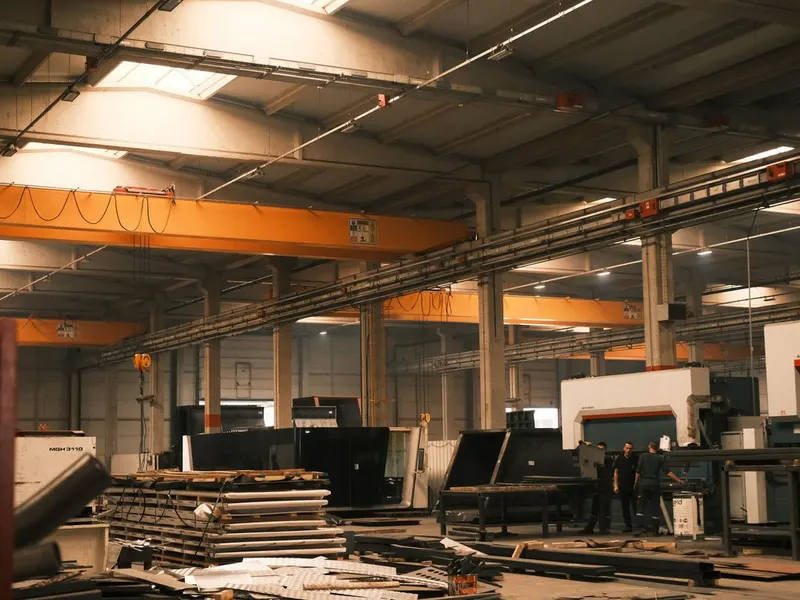
The most common industrial lifting solution, travelling on a rail line that runs along the two walls of the facility and covering the entire production area.
What it is and how it works
An overhead crane consists of a bridge that moves on two rail lines running along the long sides of the facility, and a trolley that moves crosswise on this bridge. Thanks to three-axis motion it serves the entire area covered by the building — which is why it is the most widely used lifting system in enclosed production facilities.
It is manufactured in two main types: single girder and double girder. In the single girder type the trolley runs suspended from the lower flange of the girder; it is light, economical and adapts more easily to existing steel structures. In the double girder type the trolley runs on top of the two girders; it gives higher tonnage, wider span and more lifting height, and a maintenance platform and a second hoist can be added on top.
Technical specifications
| Feature | Value |
|---|---|
| Type | Single girder / Double girder |
| Lifting capacity | 1 – 150 tons |
| Span | Engineered according to facility dimensions |
| Motion | Bridge (longitudinal), trolley (crosswise), hook (vertical) |
| Control | Pendant control or radio remote control |
| Speed control | Variable frequency drive with soft start/stop |
| Power supply | Festoon cable or busbar line |
| Duty class | Determined according to FEM / ISO classification |
Values are typical ranges; exact values become clear during engineering, based on facility dimensions and duty class.
Where it's used
- Machine manufacturing workshops
- Iron-steel and foundry facilities
- Automotive sub-industry
- Die shops and press lines
- Power plants and maintenance hangars
Technical terms
| Term | What it means |
|---|---|
| Main girder | The girder that carries the load of the bridge. One in single girder types, two in double girder types. |
| End carriage | The carriage at the ends of the main girder that carries the wheels and the travel gearbox. |
| Trolley | The unit that carries the hoist and travels crosswise on the bridge. |
| Span | The distance between the centres of the two rail lines. |
| Hook approach | The smallest distance the hook can get to the centre of the rail line. |
| Duty class | The class determined by the load spectrum and daily usage time (FEM/ISO). |
Frequently asked questions
Should I choose single girder or double girder?
Roughly: for jobs under 10 tons, with a span not exceeding 20 metres and normal-pace operation, single girder is sufficient and more economical. If you need high tonnage, wide span, intensive shift work or maximum lifting height, double girder is preferred.
What does duty class mean, and why does it matter?
A crane is classified not only by tonnage but also by how often and how loaded it operates (FEM/ISO). A workshop that lifts a few times a day and a foundry that runs through the shift need a different duty class crane even at the same tonnage. Choosing the wrong class means early fatigue and failure.
Can it be mounted on my existing building?
In most cases yes, but it must be checked whether the building's columns and brackets can carry the crane's wheel loads. If necessary, a separate free-standing structure is built for the rail line.