
Home / Our Cranes / Process Crane
Crane TypeProcess Crane
Where the crane isn't a transport tool — it's a production machine.
How it differs from a standard crane
A standard crane is an auxiliary tool; it's used a few times a day, and when it stops, work can carry on some other way for a while. A process crane sits inside the production flow: it's the crane feeding sheet coil onto the line, carrying the ladle, charging the furnace.
This difference shows up throughout the design: a higher duty class, redundant safety systems, special precautions against heat and dust, and fast-access solutions for maintenance.
Attachment and automation
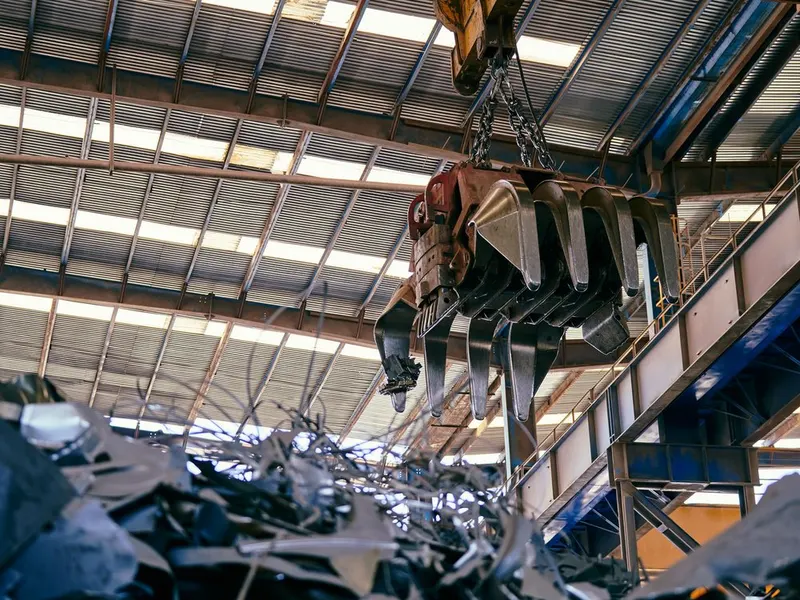
Process cranes usually work with a task-specific attachment rather than a hook: an electromagnet, a grab, a C-hook, a coil-lifting device, a ladle lifting beam. The attachment directly shapes the design of the hoist unit and the electrical supply.
For repetitive tasks, position tracking, automatic travel to a target point, sway control and data logging come into play. These systems shorten cycle time and reduce operator error.
Managing downtime
| Topic | On a process crane |
|---|---|
| Duty class | Upper groups — continuous, loaded operation |
| Attachment | Task-specific (magnet, grab, C-hook, lifting beam) |
| Automation | Position tracking, anti-sway and data logging are common |
| Safety | Redundant systems, second-stage limits |
| Maintenance | Planned, scheduled around production stoppages |
| Spare parts | Critical parts kept in stock on site |
| Cost of downtime | Quickly exceeds the cost of the crane itself |
Technical terms
| Term | What it means |
|---|---|
| Process crane | A crane that performs a continuous, dedicated duty as part of the production process. |
| Attachment | Task-specific lifting equipment used in place of a hook. |
| C-hook | A C-shaped lifting device that picks up a sheet coil from the side. |
| Ladle lifting beam | A special lifting beam used to carry a ladle of molten metal. |
Frequently asked questions
Can I use a standard crane as a process crane?
It'll work in the short term, but it's expensive in the long run. A crane operated above its duty class wears out early, and breakdown stoppages hit production.
Is automation mandatory?
No, but it pays for itself quickly on repetitive tasks. The usual priority order is: the right duty class → VFD-controlled motion → anti-sway → position automation.