
What's different about molten metal transport
A crane carrying a ladle allows no margin for error. A dropped, swung load, or a brake that fails to hold, is directly a matter of life safety. That's why redundancy is fundamental to the design: the hoisting brake is treated as dual, the upper limit is built with two stages, and the hoisting system is protected against single-point failure.
Movements must be smooth; a frequency-inverter drive and a low-speed step are used so the molten metal doesn't slosh.
Heat, sand and dust
The radiant heat near the furnace and casting line directly affects the hoist unit and electrical components. Heat shield, heat-resistant cabling and high-temperature grease are standard precautions.
Sand and dust get between the rope's wires and act like sandpaper, and speed up wheel wear on the runway. An enclosed conductor line and protected bearings make a clear difference in this environment.
Typical solutions
| Requirement | Solution |
|---|---|
| Molten metal transport | Ladle lifting beam, redundant brake, second-stage upper limit |
| Smooth movement | Frequency inverter, low-speed step, anti-sway |
| Radiant heat | Heat shield, heat-resistant cabling, high-temperature grease |
| Sand and dust | Enclosed conductor line, protected bearing and motor |
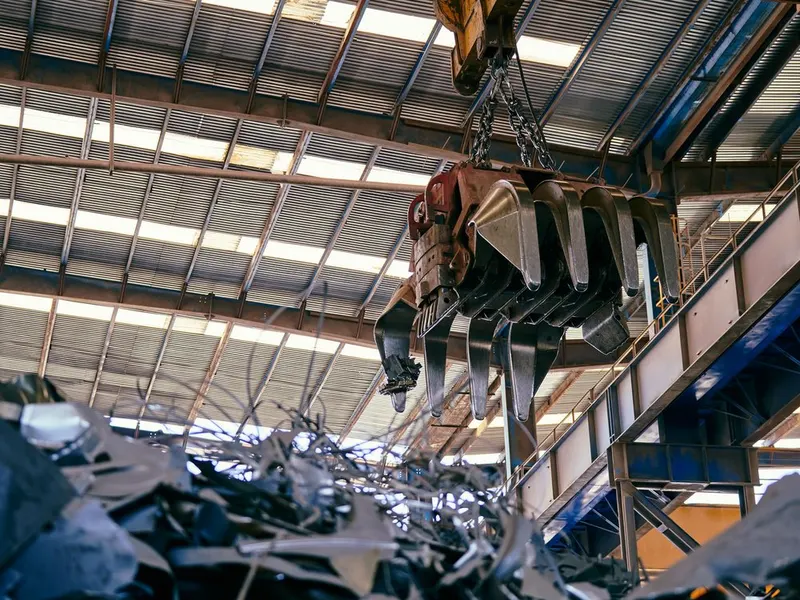
| Scrap and casting handling | Magnet or grab attachment |
| High cycle rate | Upper duty class, planned maintenance and spare parts stock |
Frequently asked questions
Is special documentation required for a ladle crane?
Molten metal transport is a high-risk application; a risk assessment and the requirements of the relevant standards are reflected in the design. The scope is defined in writing during the project stage.
Can I carry a ladle with my existing crane?
A standard crane isn't designed for this job. Redundancy, heat protection and movement quality need to be engineered from the start.