Repetitive work, high usage
In logistics facilities, loads are usually not heavy, but the number of movements is high. This pushes the duty class up through usage time rather than the load spectrum.
In such facilities, the assumption "low tonnage means a light crane" is misleading: a 5-tonne crane running all day can call for a higher duty class than a 20-tonne crane running three times a day.
Access to the loading lane
In warehouses, whether the crane can reach the truck loading lane is often decisive. A cantilevered bridge indoors, or a cantilevered gantry crane outdoors, meets this need: the hook extends beyond the rail track to reach over the truck.
Typical solutions
| Application | Solution |
|---|---|
| Indoor warehouse transport | Single or double girder overhead travelling crane |
| Open stockyard | Gantry crane |
| Truck loading lane | Cantilevered bridge or gantry |
| High cycle rate | Inverter speed control, high duty class |
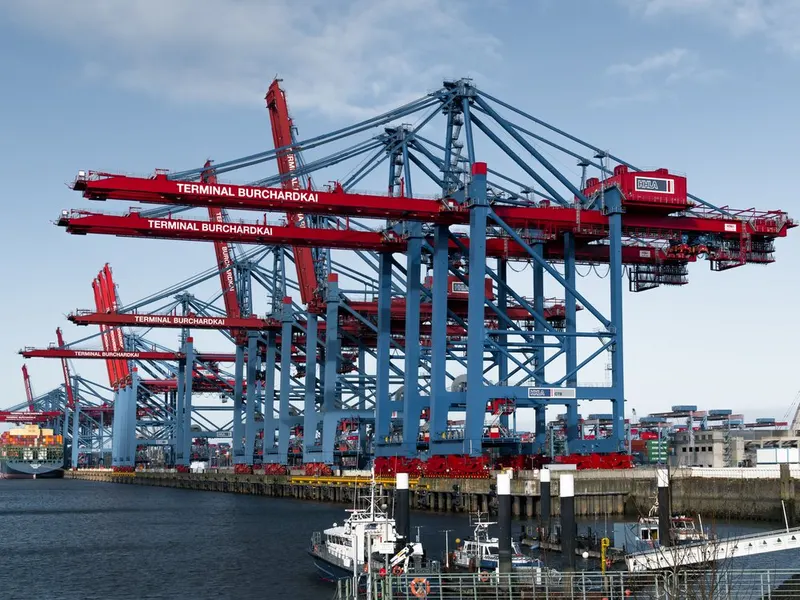
| Container handling | High-capacity gantry, spreader attachment |
| Fixed route | Monorail line |
Frequently asked questions
Do I need a crane if I already have a forklift?
They solve different jobs. A forklift excels at horizontal transport, a crane at vertical lifting and precise placement in tight spaces. For heavy, bulky loads a crane is generally safer and faster.
Does an outdoor crane work in winter?
Yes, with a suitable IP rating, a heated panel and a storm anchor. However, operation is halted for safety above a defined wind speed.
Other sectors
Manufacturing gallery