Typical demand profile
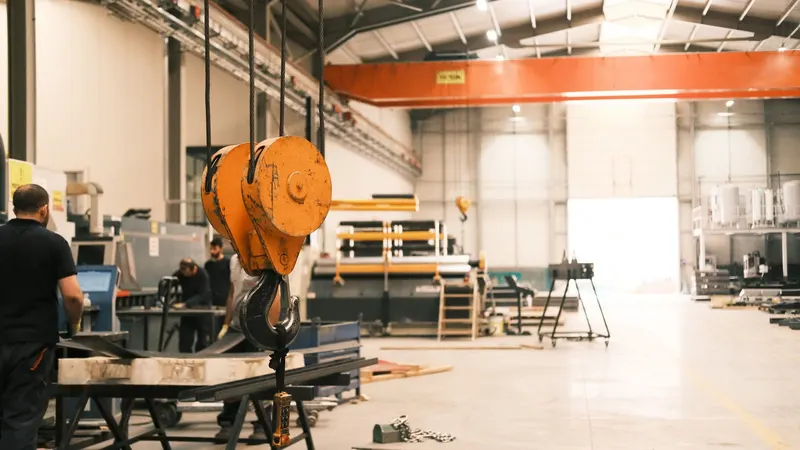
In a machinery manufacturing workshop the crane runs all day, but loads near full capacity are rare: loading a machine, moving a part to the welding table, taking it to the paint shop. In other words, usage time is high but the load spectrum is moderate.
This profile is most often met by a single girder or a light double girder crane in a medium duty class.
Hook approach is decisive
In workshops, machines are usually lined up along the walls. If the hook can't get close enough to the wall, the crane may look like it covers the whole floor on paper but still can't service those machines.
That's why in workshop cranes, hook approach distance needs to be discussed from the start, just like span and tonnage.
Common solutions
| Requirement | Solution |
|---|---|
| General workshop transport | Single girder overhead travelling crane |
| Machines close to the wall | Trolley type with low hook approach |
| Part turning | Auxiliary hook or second hoist unit |
| Single-machine feeding | Jib crane |
| Paint shop / shot-blasting line | Monorail transport line |
| Lifting tall parts | Double girder crane — more lifting height |
Frequently asked questions
How many tonnes should I get for my workshop?
Calculate the heaviest part you'll lift, together with the weight of the sling and lifting beam. If there's a chance you'll take on heavier work in the future, say so up front — increasing capacity later means replacing the crane.
Can I hang a crane on my existing steel structure?
Yes, if a structural check confirms the columns and trusses can carry the crane's wheel loads. If not, a separate leg structure is built for the rail track.
Other sectors
Manufacturing gallery