
The cycle time issue
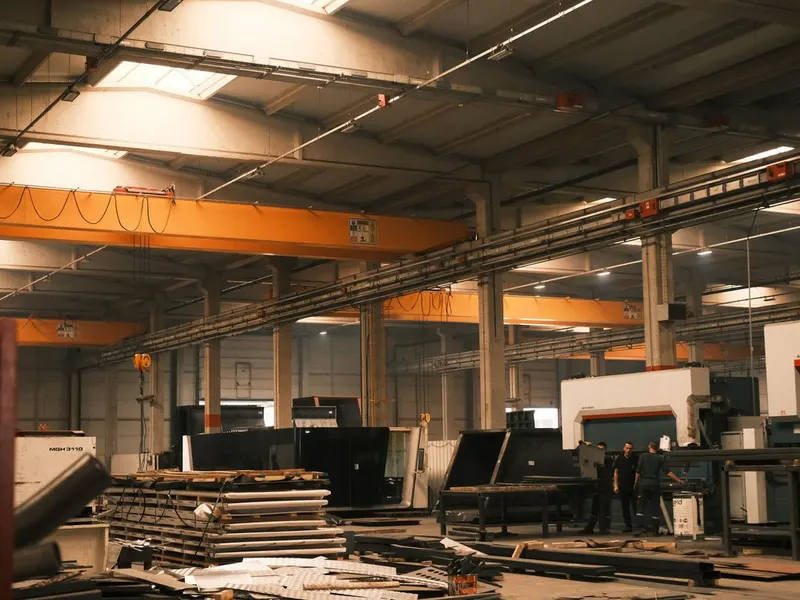
In automotive plants, the crane has to keep pace with the production rhythm. Waiting for the load to stop swinging, being unable to position at low speed, or the hook failing to reach the desired point — all of this shows up directly in cycle time.
That's why in these plants, crane selection is less about capacity and more about the speed profile, hook approach distance and positioning precision.
Die changes
On press lines, die change is a planned stop and its duration is a direct production loss. Taking the die out of the press and setting the new one in place to the millimetre demands precise, repeatable movement from the crane.
The typical solution here is inverter-controlled hoisting and travel, a low-speed step and a radio remote control that lets the operator see the load directly.
Station-based solutions
| Requirement | Solution |
|---|---|
| Die changing | Inverter-controlled double girder crane, low-speed step |
| Single-machine feeding | Jib crane — doesn't tie up the shared overhead crane |
| Fixed-route transport | Monorail line |
| Precise placement | Frequency inverter, radio remote control |
| Intensive cycles | High duty class, anti-sway |
| Ergonomics | Balancer and manipulator solutions |
Frequently asked questions
Does every machine need its own jib crane?
No, but it pays off quickly at stations with frequent lifts. Calling in the shared overhead crane every time holds up the line.
Is radio remote control safe?
Yes, when chosen correctly — in fact it can be safer: the operator is not under the load, but standing where they can see it best. Emergency stop and pairing safety are standard features.