
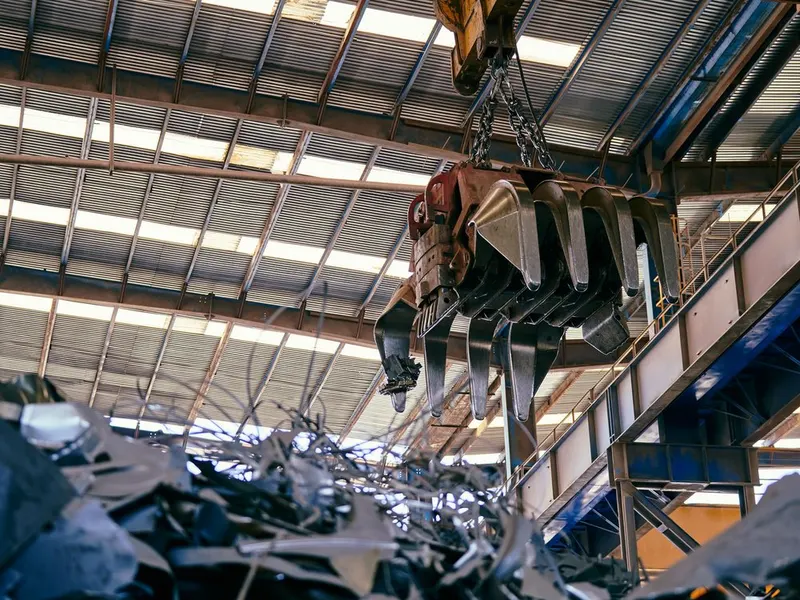
Why it's a demanding environment
In iron and steel plants, the crane is essentially the production line itself: if it stops, the line stops because of the crane. Loads are heavy, cycles are frequent and the environment is hot. Most of the hook's working time is spent close to capacity — in other words, the load spectrum is heavy or very heavy.
Under these conditions a crane is selected by duty class, not by tonnage. A crane built for the same tonnage but a lower duty class will last a few months here, not a few years.
Heat and dust
In cranes working near hot metal, heat directly shortens the life of the hoist unit and electrical components. A heat shield, heat-resistant cabling and high-temperature grease are standard precautions.
Dust, on the other hand, accumulates in two places: between the wires of the rope and on the runway. In a greased rope, dust acts like sandpaper; on the runway it speeds up wheel wear. In these environments an enclosed conductor line is noticeably superior to a festoon cable system.
Typical solutions
| Requirement | Solution |
|---|---|
| Heavy, continuous operation | Double girder crane in a high duty class |
| Hot zone | Heat shield, heat-resistant cabling, high-temperature grease |
| Dusty environment | Enclosed conductor line, protected motor and panel |
| Precise positioning | Frequency inverter and low-speed step |
| Scrap and casting handling | Magnet, grab or special attachment |
| High cost of downtime | Planned periodic maintenance and critical spare parts stock |
Frequently asked questions
Can you build a crane with a magnet or grab attachment?
Yes. If the attachment type is defined from the start, the hoist unit, power supply and controls are engineered accordingly. Adding an attachment later often actually reduces the usable capacity of the hoist unit.
How much does crane service life shorten in a hot environment?
It depends on the precautions taken. There is a clear difference on site between a crane with a heat shield and correct material selection and one without any protection; giving an exact ratio isn't possible without measuring the environment.