
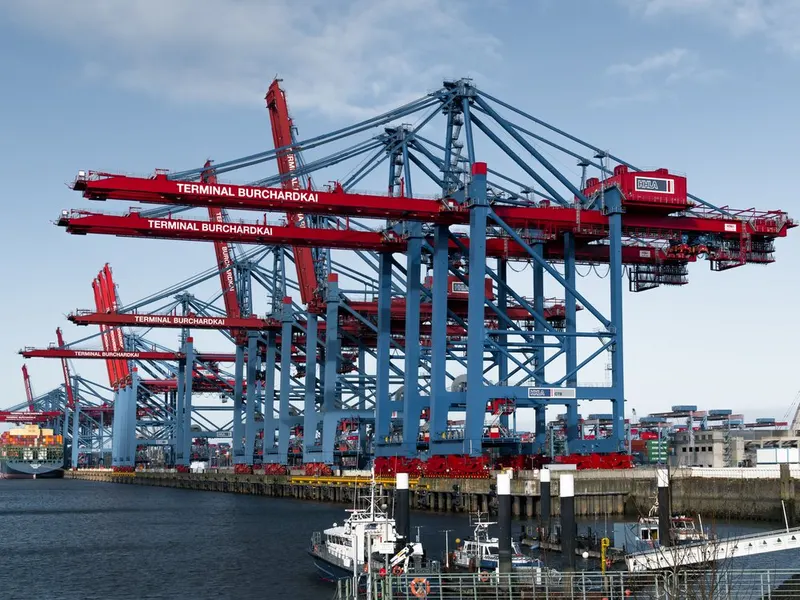
Why gantry cranes
Marble quarries and stockyards are open areas; there is no building above them to carry a crane rail. A gantry crane solves this by carrying the bridge on its own legs, running on a rail track laid on the ground.
In cantilevered types, the bridge extends beyond the legs. This makes it possible to reach the truck loading lane from outside the rail track — a major practical advantage on site.
Characteristics of block handling
A marble block causes problems as much through its geometry as its weight: the centre of gravity is uncertain, the surfaces are irregular and it tends to rotate once lifted. That's why the rigging method needs to be engineered as carefully as the lifting equipment itself.
Smooth start and stop are critical in block handling; a sudden movement swings an unbalanced load. A frequency inverter here is not a comfort feature but a safety item.
Outdoor site conditions
| Condition | Precaution taken |
|---|---|
| Wind | Storm anchor (rail clamp), anemometer if required |
| Rain and humidity | Elevated IP-rated motor and panel |
| Dust | Enclosed conductor line, protected bearings |
| Ground settlement | Reinforced concrete beam under the rail, ground survey |
| Unbalanced block load | Suitable sling/lifting beam, inverter-controlled smooth movement |
| Sun and UV exposure | UV-resistant cable and sheathing, suitable paint system |
Frequently asked questions
Is a ground survey mandatory for the rail track?
Yes, if you are installing a permanent track. Leg wheel loads are point loads and high; if the ground's capacity to carry this load isn't verified, the track settles over time and the span and level go out of tolerance.
When does a semi-gantry make sense?
When one side of the site has a suitable building or corbel that can carry the crane rail. It saves space on site and lowers cost.